

Paul Green
Founder
Paul moved to Guanajuato in 2018 and founded My Mexico Move in 2021. He writes the guides and builds the city profiles, tools and member platform.
City profile · Sonora
A quiet fishing town on the Sea of Cortez west of Hermosillo, where Arizona snowbirds winter in RVs and modest houses and summer belongs to Hermosillo families.
Verified November 2026
Bahia de Kino, called Kino Bay in English, is a fishing town on the Sea of Cortez about 107 kilometres west of Hermosillo, the capital of Sonora, on Highway 16. It is the closest real beach to Hermosillo and the quieter half of the Sonoran coast: no resort strip, no nightlife scene, just a working fishing village at one end and a long beach strip of rental houses, condos and RV parks at the other, looking out at Isla Tiburon, the largest island in Mexico. About 5.5 hours from Tucson and about 250 miles from the Nogales crossing, it is the Arizona snowbird beach that never became a resort town, and that is exactly why the people who winter here chose it.
The town is small. Wikipedia puts Bahia de Kino at about 7,000 people in 2008 and says it is home to between 6,000 and 8,000 permanent residents, Wikivoyage puts it at about 6,000 in 2010, and Geonames lists 6,050. Either way it is a town of a few thousand, and the population swings twice a year: in winter a small but visible community of American and Canadian retirees lives in RVs and modest houses, mostly in Kino Nuevo, and in summer the town fills with families from Hermosillo escaping the extreme desert heat inland. The winter tourists are gringos and the summer tourists are Mexicans from Hermosillo, and the town changes character completely between the two seasons.
The town is named after Padre Eusebio Kino, the Jesuit priest who travelled this region in 1685 and, according to Wikipedia, believed he visited the bay and named it Bahia San Juan Bautista. The bay itself is the water between Isla Tiburon and Punta San Nicolas. The coast and the land behind it are the traditional territory of the Comcaac, the Seri people, who now live to the north in Punta Chueca and El Desemboque, and whose permission is needed to visit Isla Tiburon. That living Indigenous presence, the fishing fleet, and the desert that runs straight down to the sand are what make Kino different from every resort beach further south.
Travel advisory: Sonora is at Level 3 (Reconsider Travel) in the US State Department Mexico advisory dated 11 August 2026, because of terrorism and crime, and the advisory says criminal activity and violence may occur in any area of Sonora. Bahia de Kino is, however, one of only five places in the state the advisory names as places US government employees may travel to: Hermosillo, Bahia de Kino, San Carlos-Nuevo Guaymas, Alamos and Puerto Libertad. Read that distinction carefully. It does not make the town risk free, and it does not cancel the Level 3 rating. It means the town itself is on the permitted list while much of the rest of the state is not. The full picture, including what that level does and does not mean for a move here, is in the Safety section below.
Bahia de Kino is flat, spread out along one shoreline, and built for a car. The two ends of town, Kino Viejo and Kino Nuevo, are about ten minutes apart by car, and Kino Nuevo itself is a single long strip running parallel to the water, with development on both sides. Parking is not an issue anywhere, and this is not a colonial town with cobblestone lanes. Walking works inside each end of town, and bicycles are a common sight, but getting between the two ends, to the shops, or anywhere beyond the beach without a car is a plan, not a given.
The drive from Hermosillo is the trip every resident makes repeatedly. Highway 16 runs west from Hermosillo to Kino, 107 kilometres, no toll, one lane each way with a shoulder, about 1 hour 15 minutes to 1 hour 30 minutes by car. Drive it in daylight and watch for slow trucks. Hermosillo airport, the closest airport with scheduled service, is about 110 kilometres away, about 2 hours by bus according to Wikivoyage. From the Nogales crossing it is about 250 miles and five hours, via Highway 15D south to Hermosillo and then Highway 16 west. Sonora is a hassle free zone for vehicles, so no temporary vehicle import permit is needed to drive in the state, but a tourist permit (FMM) is still needed for a stay of snowbird length.
Without a car, the option is a local bus. Transportes de la Costa runs from a station in downtown Hermosillo to Kino, with a morning and an evening departure and a fare of roughly 200 pesos one way, according to Hermosillo locals quoted in a November 2026 guide. The line has no website and no updated social page, so the only way to confirm a time is to call. No verified timetable, no verified fare table and no verified taxi fare table for Kino itself are published on this page, so confirm times on the ground before you plan around the bus. Inside town there is no verified local bus service; residents drive, cycle or walk.
Kino is two distinct places sharing a name, and knowing which is which matters when you book or rent. Think in two ends, not in neighbourhood names, because the town has no formal neighbourhoods that listings agree on.
Kino Viejo (Old Kino). The original fishing village, founded as a fishing town in the mid 1930s, where the pangas launch, the fish market sits, the pier stands, and most of the Mexican population lives. The seafood row, the taco stands, the small shops and the basic services are here. It has a few motels and at least one RV park, the beachfront Islandia Marina, and a newer park in the village with a playground and pick up soccer. It is the most Mexican feeling part of town, the cheapest, and the least polished. The old part has good old style simple restaurants and basic shopping, and no large supermarket.
Kino Nuevo (New Kino). The newer strip running north along the beach, about a mile further down the highway from Kino Viejo, and the place where nearly all the North American houses, condos and RV spots are. A single road, Avenida Mar de Cortes, runs parallel to the water with development on both sides: villas and low rise condos on the beach side, houses, RV parks and a few hotels on the other. It is very comfortable for gringos and very safe in the Wikivoyage sense, quiet, low rise, and largely empty in summer when the snowbirds leave. Most snowbirds base in Kino Nuevo and drive into Viejo for fish, tacos and hardware.
Kino Bay Estates and the gated pockets. Inside and beside Kino Nuevo are small gated residential pockets, including Kino Bay Estates on Boulevard Mar de Cortes, with modern houses, a community pool, and short to medium term rentals aimed at remote workers and snowbirds. These are the most turnkey rentals in town and the most expensive per square metre, and they are where a first season renter who wants a pool, Wi-Fi and a locked gate usually lands.
Punta Chueca, 25 kilometres north. Not a neighbourhood of Kino but the Comcaac (Seri) community on the coast north of town, where the day trip to Isla Tiburon starts. It is a separate Indigenous community on communal land, not a suburb, and visits are by arrangement with Seri guides, not by wandering in.
No verified per-neighbourhood rent table is published on this page. The honest way to choose is a scouting stay: a week in Kino Viejo and a week in Kino Nuevo will tell you more than any rent table could, and you should drive the Hermosillo road, test the water pressure, and walk the beach at the property before committing.
Daily shopping in Bahia de Kino splits three ways: the village shops, the fish, and the Hermosillo run. Kino Viejo has small grocery stores, convenience shops, pharmacies, a bakery, and the fishmongers selling the morning catch. Kino Nuevo has small shops and the Franko supermarket, described by one rental listing as the best stocked in the area, with fruit, vegetables, meat and groceries. There is no large supermarket and no Walmart in Kino itself, and the big weekly shop, including Costco and the large supermarkets, is in Hermosillo, about 90 minutes away. Most residents combine the two: fresh fish and produce in town, and a Hermosillo run for everything else.
The fish is the market. Fishermen unload at the pier in Kino Viejo in the morning, and by noon the catch is on plates in the seafood restaurants a few blocks away. Chocolate oysters, the local specialty, are sold by street vendors in Kino Viejo, and the fishmonger opposite the bakery sells fresh seafood daily. There is no verified farmers market, no verified market day, and no verified produce price list for Kino itself, so do not plan a food budget around one. Market produce is cheap where it exists, imported goods and familiar North American brands cost considerably more and are patchy, so most residents cook with what the town sells and treat the import aisle in Hermosillo as a treat, not a staple.
Cash matters. Restaurants in Kino Nuevo generally accept cards, but Kino Viejo is mostly cash only, and ATMs in Kino Nuevo are available but unreliable during peak season, according to a November 2026 restaurant guide. Bring pesos from Hermosillo, and keep cash in the house for the fishmonger, the taco stands and the small shops.
Bahia de Kino has a small but vibrant winter population of Americans and Canadians, mostly retired, living in RVs and modest homes in Kino Nuevo and Kino Viejo, according to Wikivoyage. It is not a large expat scene by Mexican beach town standards, and that is the point. The winter community is small enough to know by name, centred on the RV parks, the beach, the fishing, and the seasonal calendar: a Chili Cook Off, a carnival, Navy Day, a fishing tournament, and a welcome for the snowbirds, with the Seri community festival at Punta Chueca. The Kino Bay RV Park runs a Club Deportivo, a sports club visitors can join short term, which offers recreation, fishing advice and a social base. In summer the foreign community mostly leaves, and the town belongs to Hermosillo families.
The social scene is practical rather than organised. There is no verified expat club, no verified English language church or volunteer group list, and no verified count of the foreign population for this profile, so no expat population figure is stated here. What the evidence does show is a returning community: RV park reviewers describe the same people coming every year, with many RVs permanent and the same residents wintering over for three years or more. The parks are the social world, and the people who stay year round tend to be the ones with Mexican friends, Spanish, and a life that does not depend on the winter calendar.
English is commonly spoken within the winter community and in some businesses in Kino Nuevo, but Spanish is the primary language, and the market, the bus, the mechanic and the landlord all run in Spanish. The town still feels like a working fishing village rather than a purpose built expat destination, and the buying pressure that has changed other Sonoran beaches has not yet remade Kino. Come as a neighbour, not as a buyer of a view, and the town will treat you accordingly. Bahia de Kino links both ways with Hermosillo, the city that supplies its hospitals, its airport, its big shops and most of its summer visitors.
Rents below are realistic 2026 ranges for decent long term rentals in Bahia de Kino, built from live listings checked November 2026. Expect wide variation by furnishing, distance from the beach, and season: beachfront and short term places run much higher, and winter snowbird rates are not long term rates. Dollar conversions use 18.62 pesos to the dollar, the Banxico closing rate of 11 November 2026. The listing sample for Kino is thin, so these ranges are estimates built from that sample, not a verified market range, and the thinness itself is part of the picture.
Small house, long term. About $320 to $810 a month. Rentola listed 11 houses for rent in Bahia de Kino in November 2026, with prices from MXN 3,000 to 15,000 a month, and a 2 bedroom, 66 square metre semi furnished house in Kino Nuevo, four blocks from the beach, with a one year minimum, at MXN 15,000 a month. A 4 room, 230 square metre house on Avenida Mar de Cortes in Kino Nuevo was listed at MXN 6,000 a month, and Rentberry's local snapshot put the minimum monthly rent at MXN 6,000 across 13 properties. The MXN 3,000 listing is a 12 square metre two room house, so it is not a realistic small house benchmark, and the range above uses MXN 6,000 to 15,000. Treat it as an estimate built from a live listing sample, not a verified market range.
Larger or beachfront houses. About $810 to $1,300 a month for long term. The top of the Rentola range is MXN 15,000, and the monthly rate for a private guest suite at Kino Bay Estates, five minutes from the water, was $1,299 a month in November 2026. A four bedroom beachfront house with a pool was listed for sale, not rent, at MXN 19,500,000, which shows where beachfront purchase prices sit but is not a rent. Short term pricing is much higher per month: Airbnb showed about 370 stays in early November 2026 from $40 a night before fees, and $70 a night for beachfront, and a Flatio listing in Kino Bay Estates was 820 euros per 30 days, with a 60 day maximum stay, which is a medium term rate, not a long term lease.
RV parks, the cheapest way to winter here. Kino has long been an RV town, and the parks are the cheapest way to sleep near the water. Kino Bay RV Park in Kino Nuevo is listed at $14 to $21 a night, and Islandia Marina RV Park in Kino Viejo, a beachfront park with hookup sites, tent spots and a few cabins, was $18 a night in January 2017 reviews and $318 a month in December 2007 reviews, both stale, with a March 2026 guest paying 180 pesos per person to car camp next to the beach. No verified current monthly RV rate is published on this page, so confirm the winter monthly rate directly with the park before you plan a season around it. Water pressure in the parks is low, and reviewers advise filling the tank and running off the pump.
Utilities and deposits. Rentola advises that dealing directly with an owner in Bahia de Kino usually means extra costs averaging MXN 2,500 to 6,000 a month on top of rent, and 2 to 3 months rent to cover initial costs. Electricity is billed by the CFE every two months, and in a hot desert town the air conditioning bill is the number that moves, so a top floor place with all day air conditioning will cost far more to cool than a shaded ground floor place with a breeze. Most long term rentals move through local Facebook groups, word of mouth and local agents, and some properties are never formally listed online. Budget a scouting stay and search on the ground, and do not sign a lease from abroad.
Bahia de Kino is on the coast, inside Mexico's restricted zone, so a foreign buyer needs a fideicomiso bank trust to hold residential property here, with the federal SRE permit fee at MXN 21,650. That is one more layer than in an inland city, and it is not optional. A notario publico, not a title company, is the legal figure who closes a sale in Mexico, and beachfront property needs extra care.
No verified current purchase price range is published on this page, because no reliable market wide source exists for Bahia de Kino. What the evidence does show is the shape of the market: small houses near the beach, traditional Mexican homes, renovated foreign owned properties, larger beachfront villas with pools, and the gated pockets of Kino Nuevo, with beachfront commanding a large premium over inland houses. Listed examples from November 2026 include a four bedroom beachfront house with a pool at MXN 19,500,000 and a four bedroom house at MXN 3,068,937, which show the spread but are not a range. Rent first, for at least a year and through a summer, and buy only after you know which end of town, which beach and which water supply you can live with.
Three checks matter more than any price. First, the town is a fishing village on a desert coast, so inspect the water supply, the water pressure and the storage tanks at the property itself. Second, the coast and the land behind it are Comcaac (Seri) traditional territory, so a lot near the shore or the lagoon needs its legal and environmental status checked before you buy. Third, a house in a hot, dry, salt air coastal town needs ongoing maintenance against damp, salt and sun. Get an independent notario and an independent lawyer, check the property is not ejido land, and budget for that maintenance.
Day to day healthcare in Bahia de Kino is basic, and that sentence needs its second half: serious care leaves the town. Kino has small clinics and pharmacies for routine needs, but no hospital is verified in the town itself, and no verified clinic list, English speaking doctor list or private consultation prices are published on this page, so do not plan your care around any of them. If you have a major ongoing condition that needs frequent specialist care, the 90 minute trip to Hermosillo belongs in your decision, not in a footnote.
Hermosillo, about 107 kilometres and 90 minutes away, is the hospital base, and it is a strong one. The names residents use are Hospital CIMA Hermosillo, on Paseo Rio San Miguel, with a 24 hour emergency room, intensive care, surgical rooms, labs, CT and MRI, and an emergency number of 662 259 0911; Hospital Medica de la Ciudad, on Boulevard Paseo Rio Sonora; and Hospital Privado de Hermosillo. We have not verified English language service or insurer billing at any of them, so confirm those in person. In an emergency, dial 911.
Two gaps matter. First, no IMSS facility is verified in Bahia de Kino itself, so public care means Hermosillo, and foreign resident access rules should be confirmed locally before relying on them. Second, the heat is a health factor here, not a footnote: summer daytime highs reach about 36 degrees C, and the desert sun, the dry air and the long drive to a hospital all argue for a car, a charged phone, drinking water, and a plan for who drives you to Hermosillo if you cannot drive yourself. IMSS voluntary enrollment is available to legal residents, and it is the cheapest backstop in the country, but it has waiting periods and pre existing condition exclusions, so read the current rules before you rely on it. Private insurance bought locally is the usual complement for people who want faster access. Most residents here run a hybrid: local clinics and pharmacies for routine needs, Hermosillo for everything serious, and IMSS or private insurance as the financial backstop.
| Facility | Type | What the profile says |
|---|---|---|
| Local clinics and pharmacies, Bahia de Kino | Private, local | Basic care reported; no verified list, no verified hospital in town |
| Hospital CIMA Hermosillo | Private | 24 hour emergency room, ICU, CT and MRI, about 90 minutes away |
| Hospital Medica de la Ciudad, Hermosillo | Private | Private hospital in Hermosillo, about 90 minutes away |
| Hospital Privado de Hermosillo | Private | Private hospital in Hermosillo, about 90 minutes away |
| Hospital San Jose, San Carlos | Private | Private hospital on the coast south of Hermosillo, a longer drive than Hermosillo |
Bahia de Kino suits a retiree who wants the beach and low costs above almost everything else, who drives, and who is honest about the trade offs. The maths works: the estimated single person budget on this page is $800 to $1,550 a month, and the verified 2026 average Social Security benefit is $2,071 a month (Social Security Administration, 2026 COLA Fact Sheet), so a single retiree on the average benefit covers a modest Kino life, and a couple on two benefits lives comfortably. The beach is a short walk away, the winter social calendar is small but real, the water is calm and shallow, and Hermosillo is 90 minutes away for hospitals, shopping and flights.
The trade offs for retirees are the ones named across this profile: a Level 3 advisory for the state, even with Kino itself on the permitted list; routine healthcare in the town but serious care a 90 minute drive away; a hot desert climate with summer highs around 36 degrees C; a small social scene that thins out sharply when the snowbirds leave; and a town that runs in Spanish and needs a car. It is a poor fit for a retiree who needs frequent specialist care, cannot drive, or wants a large peer community that stays all year. It is a strong fit for a retiree who is adaptable, independent, comfortable in a small fishing town, and happy to trade polish for sand, sea and a community that knows their name. Come for a month in the summer, not only in the mild winter months, drive the Hermosillo road at night in your mind before you commit, and check whether 90 minutes to a hospital feels close enough for your health situation.
Remote workers can do fine here, with two caveats: internet service can occasionally be unreliable, so test the actual speed in the exact property before you sign a lease, and power and water need checking on the specific street and in the specific RV park. No coworking venue is verified by name for this profile, so do not plan your work life around one. Remote workers here work from home, from an RV, or from cafes, and the town suits people whose work is already remote and portable. One Kino Bay Estates listing aimed at remote workers advertises a bright modern house three minutes walk from the beach with fast Wi-Fi, but that is one listing, not a verified town wide speed, and no verified internet speed or price by street is published on this page.
Local work for foreigners is a different question: you need residency with permission to work, and the local job market is fishing, port work and tourism, with pay far below US levels. Teaching English is the usual foreigner option, and it pays local rates. Some foreign residents run small businesses in the wider coast area, including the restaurants and bars in Kino, but that is self employment with permits, not a job market. Nobody moves to Bahia de Kino for a local salary.
Bahia de Kino is a family friendly beach town, not a family relocation hub for foreigners, and the honest picture for families is mixed. For children, daily life is safe in the usual small town sense, with a calm shallow beach, the square and family evenings, the Seri museum, and the day trip to Isla Tiburon all within reach. The water here is flat and calm, which is why families who want calm water choose Kino, and the town suits families who want a fishing town rather than a scene. The social world tilts local and Spanish speaking, not international, and no verified list of family facilities, clubs or activities for foreign children is published here. If schooling is a deciding factor, verify specific schools on the ground before committing, and weigh Hermosillo, about 90 minutes away, which has the bilingual schools.
We have not verified the names, fees or admissions of schools in Bahia de Kino beyond the public schools named below, so families should check that in person before committing. The village has local public schools: a federal preschool, the Escuela Lazaro Cardenas primary school, a state technical secondary school, and the COBACH Bahia de Kino high school, the Colegio de Bachilleres del Estado de Sonora campus on Avenida Mar de Cortes. No international school is verified in Bahia de Kino, and no verified school fees are published on this page.
The nearest bilingual schooling is in Hermosillo, about 90 minutes away. There is no true international school and no American school in Hermosillo, according to reports from US government families in Hermosillo in June 2025 and June 2023, but there are private bilingual schools, including IMARC, the Instituto Mexicano Americano de Relaciones Culturales, which offers bilingual education from preschool to middle school, HighPoint International School, and the Irish Institute. Those schools are designed for students with Spanish as a first language, not for English speaking newcomers, and children need to be comfortable in Spanish. No verified fees, admissions or waitlists are published on this page. For a family move, the school decision and the housing decision are the same decision: price the Hermosillo school run, in time and in fees, before you sign a coastal lease.
Bahia de Kino eats Sea of Cortez seafood, and it eats it cheaply if you eat like a resident. Fresh fish and shrimp come off the pangas in the morning, ceviche is the default lunch, and the seafood restaurants in Kino Viejo serve the catch of the day. The names to know are from Wikivoyage: Las Palapas in Kino Nuevo, on Avenida Mar de Cortez, for the Filete Seri, a large fillet of whitefish topped with crunchy sauteed vegetables, with several types of ceviche and marlin tacos; El Pargo Rojo, on Avenida Mar de Cortez, for grilled octopus, whole grilled fish and enormous shrimp cocktails, about M$300; Paula, a casual palapa style restaurant on the beach for filetes in butter, chiles or garlic and huge shrimp cocktails; and Marlin, in business for over 50 years, for grilled lobsters, marlin tacos and camarones al ajo, about M$250. Luigi's Pizza, on Guaymas and Avenida Ensenada, is the reliable pizza, about M$200, with unusual flavours including surf and turf. La Pasadita, the evening taco stand in Kino Viejo, opens at 6 PM and is known for carne asada and baked potatoes stuffed with grilled meat.
Groceries for a household that cooks at home run far lower than in the US, with the usual leaks: imported wine, peanut butter, and anything that has to be shipped in. Cook from the fishmonger and the small shops most days, eat out often because it is cheap enough to, and save the white tablecloth nights for Hermosillo. The big shop is in Hermosillo, where the supermarkets cover everything the village shops do not. Cash is the rule in Kino Viejo, cards are generally accepted in Kino Nuevo, and the ATMs in Kino Nuevo are unreliable in peak season, so bring pesos from Hermosillo.
Bahia de Kino has no resort strip and no nightlife, and that is a fact, not a gap in the research. Evenings centre on the beach, the seafood restaurants, the taco stands, and the RV park clubhouses, and most places wind down early. The seasonal calendar supplies the late nights there are: the Chili Cook Off, the carnival, Navy Day, the fishing tournament, and the snowbird welcome, with the Seri community festival at Punta Chueca. The Kino Bay RV Park Club Deportivo gives short term members a social base and a sports club. Hermosillo is the late night option, about 90 minutes away. If you want a drink with a view and an early night, the coast suits you. If you want a late bar scene within walking distance, it does not, and no listing will change that.
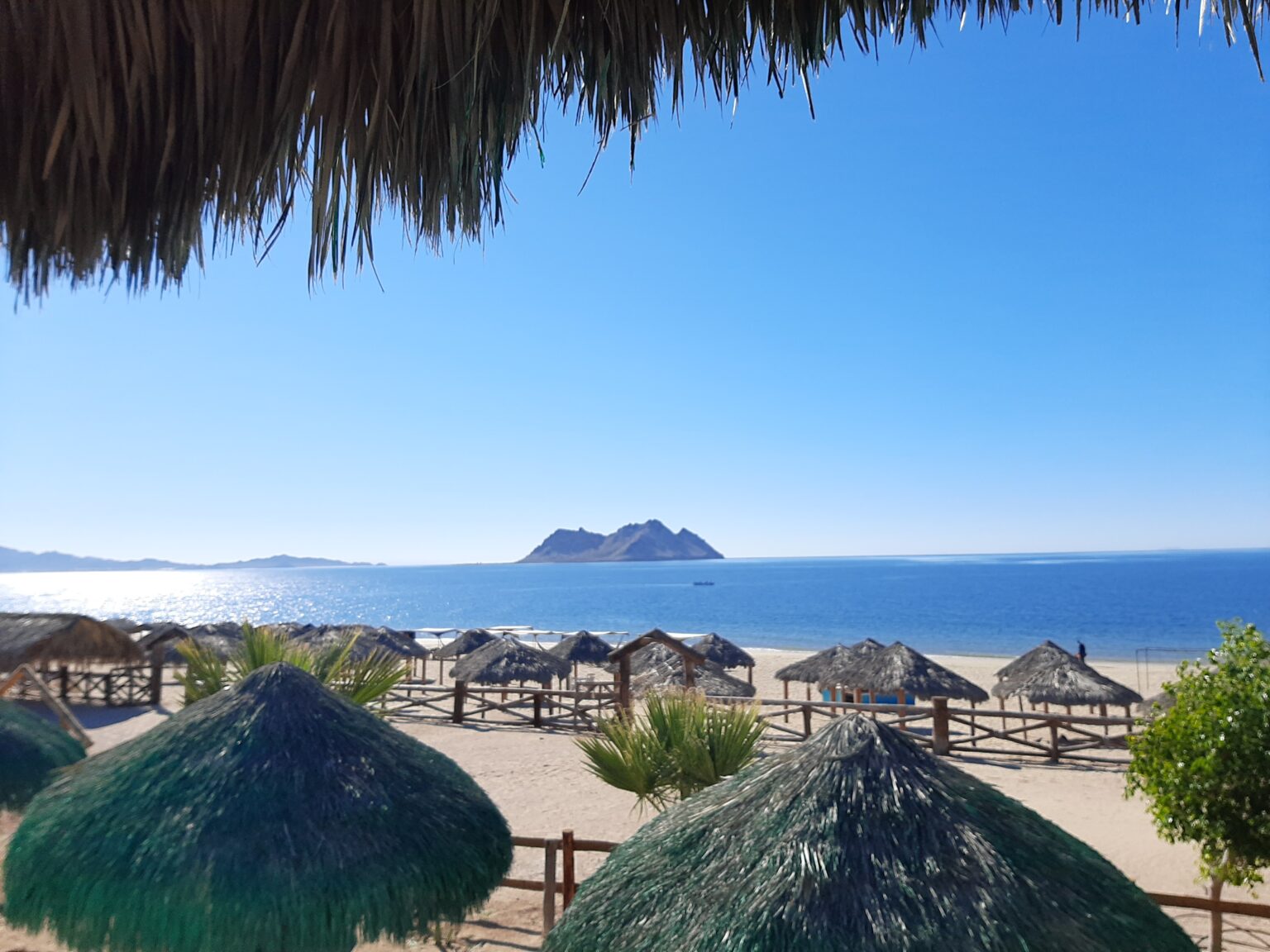
The beach here is the reason to come, and the desert is the reason to think twice. The shoreline is a contiguous sandy beach, gravel shore and low cliffs, with flat calm shallow water that stays warm into autumn, and Isla Alcatraz offshore, a protected bird island that it is against the law to set foot on. The water temperature reaches about 31 degrees C in September, according to climate data, and the sunsets over the Sea of Cortez, with Isla Tiburon across the bay, are the town's best free entertainment. No source we read places lifeguards on this beach, so the water is yours to judge, and the currents and the sun deserve respect even on a calm looking day.
Climate on this coast is hot desert, Koppen BWh, with big differences between seasons. The nearest published climate table, for Bahia de Kino itself from climate-data.org, 1991 to 2021, gives an average annual temperature of 24.1 degrees C and about 138 mm of rain a year, with daytime highs from about 22 degrees C in January to about 36 degrees C in August, the warmest month August at a mean of 32.2 degrees C, the coolest January at a mean of 16.3 degrees C, the wettest month September at about 47 mm, and the driest April at about 0 mm. The most comfortable weather is typically between November and March, when temperatures are cooler and the snowbirds arrive. Summers, particularly June to September, feel intensely hot, and the town empties of foreigners while Hermosillo families arrive for the beach. Strong winter winds can be a concern in December, January and February, and the hurricane season runs from June to November, though Kino sits in the northern Gulf and hurricanes are less frequent here than further south. No verified Kino only storm history is published on this page.
The desert is not scenery here, it is the place. Bahia de Kino is part of the Sonoran desert, the Sierra Seri rises behind the coast, and the Bosque de Cardones, the saguaro forest, sits inland. Scorpions are a real, small fact of life: reviewers warn about scorpions in the Islandia cabins and about leaving gear outside overnight. Keep shoes off the floor at night, shake them out in the morning, and treat the desert with the same respect as the sea.
Travel advisory: Sonora is at Level 3 (Reconsider Travel) in the US State Department Mexico advisory dated 11 August 2026, verified November 2026. The advisory says to reconsider travel to Sonora due to terrorism and crime, that there is a risk of violence in the state from terrorist groups, cartels, gangs and criminal organizations, and that travellers should stay alert and aware of their surroundings while travelling in Sonora, because criminal activity and violence may occur in any area of Sonora. Read the current advisory before you commit, and check it again before any trip.
The distinction that matters most for Bahia de Kino is in the same advisory. US government employees may travel to Hermosillo, Bahia de Kino, San Carlos-Nuevo Guaymas, Alamos and Puerto Libertad, and Bahia de Kino is named explicitly. That is not a clean bill of health for the state, and it does not change the Level 3 rating. It means the town itself is on the permitted list while much of the rest of Sonora, including the Nogales corridor, Cananea and Agua Prieta, and eastern and southern Sonora, carries specific restrictions. The advisory also says US government employees may not travel between cities after dark, and US citizens are strongly advised to follow the same restrictions, and that travel between Nogales and Hermosillo is during daylight hours only and via Federal Highway 15 only, with shootings reported along that route during the day. Canada, for its part, advises avoiding non essential travel to Sonora, with the exception of the cities of Hermosillo, Guaymas and San Carlos and Puerto Penasco, and Kino is not on that exception list.
The honest neighbourhood read: Bahia de Kino is a small fishing town where most visitors report uneventful trips, and Wikivoyage calls the new part of town very safe. That is not the same as risk free, and no city page can call a Level 3 state risk free, and this one does not. Petty theft and property break ins do occur, particularly in homes and RVs left empty in the off season: a December 2024 reviewer reported a theft from motorbike bags at Islandia, and reviewers warn about leaving gear outside overnight. Secure doors and windows, avoid leaving valuables visible, get to know your neighbours, and consider a caretaker if you are away long term. No verified Bahia de Kino only crime rate is published on this page, so no town crime figure is stated here. Drive the Hermosillo road in daylight, do not drive between cities after dark, use dispatched vehicles from regulated taxi stands or app based services rather than waving down taxis, and avoid travelling alone in remote areas.
A modest but comfortable single life in Bahia de Kino runs about $800 to $1,550 USD a month; a comfortable couple, about $1,150 to $2,100. Both are estimates, built from the rows below, not verified ranges, because Bahia de Kino has almost no published cost data of its own beyond the rental listings. The shape of it: rent as above, and lower than most beach towns; utilities are cheap in a mild month but air conditioning adds up fast in the hot season; groceries split between the fishmonger, the small shops and the Hermosillo run; dining out ranges from taco stands to the seafood restaurants. Transport means a car for most residents, and the Hermosillo run is a fuel cost, not a bus fare. The leaks are the usual ones: imported goods, private health insurance premiums, air conditioning, and travel back to the States.
| Item | Figure | Basis |
|---|---|---|
| Monthly total, one person | $800–$1,550 | One person, modest but comfortable, estimate |
| Monthly total, a couple | $1,150–$2,100 | A couple, comfortable, estimate |
| Rent, small house, long-term | $320–$810 | Per month, Rentola and Rentberry listings November 2026, MXN 6,000 to 15,000 |
| Rent, larger or beachfront house | $810–$1,300 | Per month, estimate; monthly suite rate $1,299, November 2026 |
| RV park, Kino Bay RV Park | $14–$21 per night | Per night, listed rate; monthly rate not verified |
| Utilities | $40–$90 | Per month, estimate; Rentola advises MXN 2,500 to 6,000 extra a month |
| Internet | About $25 | Per month, estimate; not verified for Bahia de Kino specifically |
| Groceries | $200–$300 | Per month, one person, estimate; fish and small shops in town, big shop in Hermosillo |
| Eating out | $50–$100 | Per month, estimate; seafood restaurants about M$200 to 300 a meal |
| Local transport | $40–$80 | Per month, estimate; a car adds fuel, insurance and upkeep; bus about 200 pesos one way to Hermosillo |
| Health, routine private visits and pharmacy | $30–$70 | Per month, estimate; IMSS enrolment is separate and varies |
| Miscellaneous | $40–$80 | Per month, estimate |
You will thrive if you want a quiet fishing town at low prices, you drive, you are adaptable and independent, your health is stable, and you like your foreign presence concentrated in a small winter community rather than diluted across a big city. Bahia de Kino's expat scene is small in winter and smaller in summer, and you will make Mexican friends because daily life runs in Spanish. Compare Hermosillo, 107 kilometres east, if you want the same coast with a city, hospitals, an airport and a big shop in town, or San Carlos, further south on the same coast, if you want the same sea with a larger foreign community and a resort feel.
You will struggle if you need frequent specialist care, cannot or will not drive, need totally reliable power, water and internet, want a mild climate, or want a social scene that stays full all year. The summer heat is intense from June to September, the Level 3 advisory for Sonora is a real planning factor even with Kino on the permitted list, and the market, the bus, the mechanic and the landlord all run in Spanish. The beach is calm and the town is quiet, and if that sounds like a warning rather than a promise, look elsewhere.
Bahia de Kino is the cheapest, quietest version of the Arizona snowbird dream on the Sonoran coast, and the honesty is the point. It does not pretend to be a resort, a colonial jewel or a polished town. It is a working fishing village with a long beach, fresh fish off the pangas, a small winter community that returns year after year, and the desert running straight down to the Sea of Cortez. The price of that bargain is Spanish, a car, air conditioning, a backup plan for water pressure, a 90 minute drive to a hospital, and a Level 3 advisory you must read in full before you commit. Come for a month in the summer, not only in the mild winter months, drive the Hermosillo road, test the water and the internet on any street before you sign, and check whether 90 minutes to a hospital feels close enough for your health situation. If the town gets its hooks in you the way it does for the people who return every winter, you will understand everything in this profile from the inside.
Disclosure Affiliate link: if you buy or book through it, we may earn a commission at no extra cost to you. The full disclosure
Population and geography are from Wikipedia (Bahia de Kino, town in Hermosillo Municipality, Sonora, on the Gulf of California, named after Eusebio Kino, population about 7,000 in 2008 and between 6,000 and 8,000 permanent residents, coordinates 28.81667 N, 111.93333 W, bay between Isla Tiburon and Punta San Nicolas, desert climate Koppen BWh, first permanent settlement in the mid 1930s) and Wikivoyage (about 100 km from Hermosillo, about 6,000 people in 2010, closest airport Hermosillo 110 km, about 2 hours by bus), checked November 2026. Distances are from mrplayas.com (107 km west of Hermosillo, about 5.5 hours from Tucson, 1 hour 15 minutes to 1 hour 30 minutes by car on Highway 16) and smartgringo.com (about 250 miles and five hours from the Nogales crossing, 65 miles and about 1.5 hours Hermosillo to Kino Bay). The advisory level is from the US State Department Mexico advisory dated 11 August 2026, checked 13 November 2026 at travel.state.gov: Sonora is at Level 3, in the Level 3 section of the advisory, with the date line reading Date issued: August 11, 2026, and US government employees may travel to Hermosillo, Bahia de Kino, San Carlos-Nuevo Guaymas, Alamos and Puerto Libertad. Canada's Sonora exception list, which does not include Kino, is from mrplayas.com, November 2026. Expat life is from Wikivoyage (small but vibrant winter population of Americans and Canadians, mostly retired, in RVs and modest homes) and mrplayas.com (RV and snowbird regulars, best months November through March, updated November 2026). Rents are from Rentola long term listings checked November 2026 (11 houses, MXN 3,000 to 15,000 a month, 2 bedroom 66 square metre house in Kino Nuevo MXN 15,000 a month with a one year minimum, 4 room 230 square metre house on Avenida Mar de Cortes MXN 6,000 a month, extra costs MXN 2,500 to 6,000 a month, 2 to 3 months rent for initial costs), Rentberry (13 properties, minimum monthly rent MXN 6,000), Airbnb via mrplayas.com (about 370 stays in early November 2026 from $40 a night, $70 beachfront), the Romantic Reef House monthly suite rate of $1,299 a month, and Flatio (820 euros per 30 days, 60 day maximum). RV parks are from rvparky.com (Kino Bay RV Park $14 to $21 a night), mrplayas.com (Islandia Marina RV Park, March 2026 guest 180 pesos per person car camping, December 2024 theft report, scorpion warnings) and RV LIFE reviews (Islandia $18 a night January 2017, $318 a month December 2007, both stale). The dollar conversion uses 18.62 pesos to the dollar, the Banxico closing rate of 11 November 2026. Transport is from mrplayas.com (Transportes de la Costa, downtown Hermosillo, roughly 200 pesos one way, morning and evening departure, no website) and Wikivoyage (Hermosillo airport 110 km, about 2 hours by bus). Climate figures are for Bahia de Kino itself from climate-data.org, 1991 to 2021: average annual temperature 24.1 degrees C, about 138 mm of rain a year, daytime highs about 22 degrees C in January to about 36 degrees C in August, warmest month August mean 32.2 degrees C, coolest January mean 16.3 degrees C, wettest September about 47 mm, driest April about 0 mm, sea temperature about 31 degrees C in September. Food is from Wikivoyage (Las Palapas Filete Seri, El Pargo Rojo about M$300, Luigi's Pizza about M$200, Paula, Marlin over 50 years about M$250, La Pasadita carne asada from 6 PM, chocolate oysters from street vendors) and mrplayas.com (Kino Viejo cash only, Kino Nuevo cards accepted, ATMs unreliable in peak season, Franko supermarket). Schools are from Teachers Without Borders (federal preschool, Escuela Lazaro Cardenas, state technical secondary school, COBACH Bahia de Kino) and TalesMag (no true international school in Hermosillo, bilingual schools IMARC, HighPoint International School and Irish Institute, June 2025 and June 2023 reports). Healthcare is from Lakeside Medical Group (Hospital CIMA Hermosillo, Paseo Rio San Miguel 35, 662 259 0900, emergency 662 259 0911, 24 hour emergency room, ICU, CT and MRI; Hospital Medica de la Ciudad, Boulevard Paseo Rio Sonora 138; Hospital San Jose San Carlos). The Seri and Isla Tiburon material is from Wikipedia and Springer (Comcaac population about 1,011 in 2020, Punta Chueca and El Desemboque, Isla Tiburon the largest island in Mexico, 50 km by 25 km) and mrplayas.com (Punta Chueca 25 km north, Seri guided trips, permit needed). The Museo Comcaac hours are from Wikivoyage (Wed to Fri 09:00 to 18:00, Sat to Sun 09:00 to 17:00, closed Mon to Tue, updated June 2024). The Social Security average of $2,071 a month is from the Social Security Administration 2026 COLA Fact Sheet. The fideicomiso SRE permit fee of MXN 21,650 is the current federal fee. Figures we could not verify are marked as unverified in the sections above, so you can see exactly what still needs checking on the ground.
Keep planning: price your month in our cost calculator, compare cities side by side on the city comparison page, read our safety and healthcare guides, or take the city match quiz.
Hero photo: Bahia de Kino Beach by Carlos t, CC BY-SA 4.0, via Wikimedia Commons.
Verified November 2026.
The one page brief carries this profile’s snapshot costs and rent, its healthcare frame and, where the profile states one, its advisory note, printed word for word.
No ratings yet. The average appears after 5 ratings, so one score cannot pose as a verdict. To rate this city profile, leave a comment below and pick your stars in the comment form. First comments are held for a quick moderation check before they appear.
Corrections and first-hand tips are welcome. Keep comments on topic and kind, and please do not share personal immigration case details here. Read the Comment Policy before posting.
Who’s behind the site
We are Paul and Adriana, and we run My Mexico Move together: Paul from the guides and the platform side, Adriana from Guanajuato, where she leads our partnerships and the ground work behind every profile.

Founder
Paul moved to Guanajuato in 2018 and founded My Mexico Move in 2021. He writes the guides and builds the city profiles, tools and member platform.

Partner
Adriana Vaca is Paul’s partner and leads partnerships and operations at My Mexico Move. Based in Guanajuato, she builds the relationships with the Mexican businesses in our directory, reviews our Spanish-language content so it reads the way it should, and runs the Mexico ground work our guides and city profiles depend on. A broadcaster by trade, she presented on Exa FM Irapuato and has worked as a commercial voice talent since 2017. Her studio, Voice con Vida, produces the audio across our sites.
Say hello any time, or write to us through the contact page.