

Paul Green
Founder
Paul moved to Guanajuato in 2018 and founded My Mexico Move in 2021. He writes the guides and builds the city profiles, tools and member platform.
City profile · Jalisco
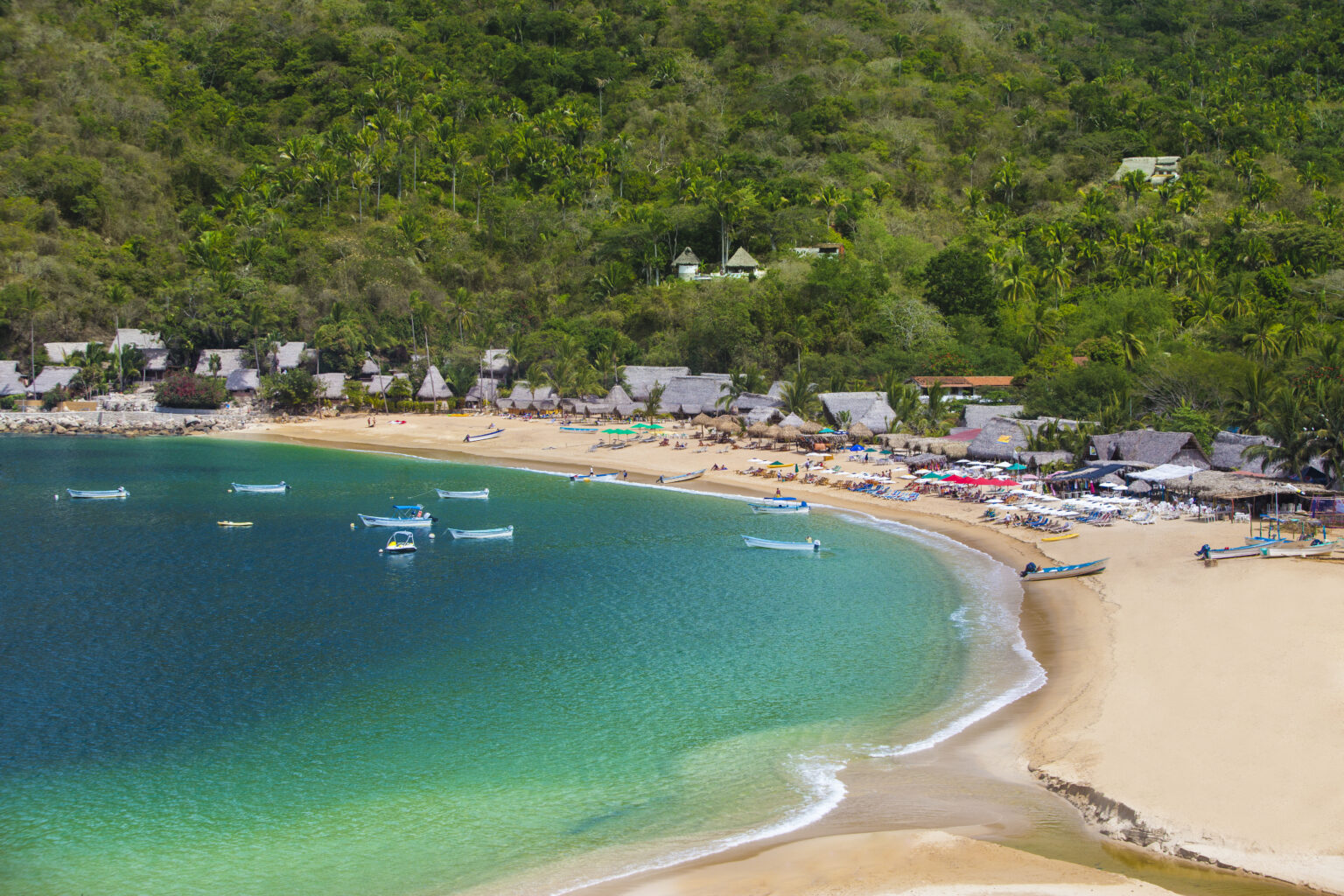
A car-free cove south of Puerto Vallarta, reached only by boat, where a bohemian expat community lives off the grid on communal land.
Verified November 2026
Yelapa is a small beach town in the municipality of Cabo Corrientes, Jalisco, in the southernmost cove of Bahia de Banderas, about 45 minutes by boat south of Puerto Vallarta. The 2020 census counted 882 residents in the Yelapa locality, 444 men and 438 women (INEGI), while local estimates of the wider village run higher, around 1,500. The village sits at just 1.2 metres above sea level, where the Rio Tuito meets the sea, which is what the name is traditionally said to mean: where two rivers meet the sea.
What makes Yelapa different is not one thing but the combination. There is no road in and there are no cars. Everything and everyone arrives by boat. Most of the land is held communally by an Indigenous community, so outsiders generally cannot buy land outright. Electricity and telephone service only arrived in 2001. There are no ATMs, no streetlights, no supermarket and no chain anything. Mules still carry goods along the footpaths. And for decades the village has drawn artists, musicians and seasonal residents who came for exactly that: a car-free, off-grid cove where the day is set by the boats, the river and the weather.
The honest bargain is simple. You get one of the most beautiful coves on the Mexican Pacific, a small and genuinely mixed community, and a life stripped of traffic, noise and most of modern friction. What you give up is convenience at every turn: every bag of groceries, every parcel, every doctor visit and every trip to an ATM means a boat to Puerto Vallarta. If you want a quiet, boat-access life and you can live with that trade, Yelapa is unlike anywhere else on this site. If you need reliable power and internet, a hospital nearby, or a deed with your name on it, look elsewhere, starting with Puerto Vallarta, 45 minutes north by boat.
Travel advisory: Jalisco is at Level 3 (Reconsider Travel) in the US State Department Mexico advisory dated 11 August 2026. The full picture, including what that level does and does not mean for a remote cove like Yelapa, is in the Safety section below.
There are no streets in Yelapa in the usual sense. The village is a network of cobbled footpaths, stone steps and dirt tracks threaded between the beach, the river and the jungle hillsides, crossed by footbridges over the Rio Tuito. There are no cars and no municipal roads. Transport inside the village is on foot, by mule or horse, by ATV, or by small boat along the shore. The main beach sits on the east side of the cove, the village on the west side, and the river runs into the sea between them. The point and Playa Isabel are at the west end, and the lighthouse stands on the hill above the main beach.
Walking is the daily reality, and it is steep in places. Houses on the hillsides are reached by long flights of steps, one long-term rental listing notes a house about 80 steps down from the main street, and the paths are unlit at night, so residents carry a flashlight. There are no streetlights in the village. In the rainy season the paths get slick and the river crossings rise, and sturdy sandals or walking shoes matter more than any vehicle.
Getting in and out means the water taxi, locally called a panga. There are two departure points in Puerto Vallarta. From Los Muertos Pier in the Romantic Zone the ride takes about 45 to 55 minutes, and scheduled public water taxis listed by Go2Yelapa in September 2026 cost 350 pesos one way, about $19 at 18.62 pesos to the dollar. From Boca de Tomatlan, the fishing village about 20 minutes south of Puerto Vallarta by road, the ride takes about 25 to 30 minutes and costs 130 pesos one way, about $7. Other recent reports put round trips from Los Muertos at roughly 380 to 500 pesos, so check the fare and the last boat back at the pier the day before you travel. Boats run a handful of scheduled departures a day, with the last return in the late afternoon, and you should plan every boat trip in daylight. In rough weather or a closed port, boats do not run, and Yelapa waits.
Yelapa has no colonias with rent tables. It has four kinds of place to live, and the choice between them is the biggest housing decision you will make.
The beach. The crescent of sand on the east side of the cove, lined with palapa restaurants, loungers and the piers where the water taxis land. The most convenient base and the noisiest in the middle of the day, when the day-trip boats arrive. Best for a short stay and for anyone who wants the sea at the door, worst for quiet and privacy.
The village. West of the river, around the paths, cafes, taco stands and family-run spots. This is where daily life happens: the three small markets, the school, the clinic, the murals and the papel picado over the lanes. The best choice for living like a resident rather than a visitor, and the easiest place to be without a boat on any given day.
The river. The quiet stretch along the Rio Tuito between the beach and the village, where the water runs past houses and the paths cross on footbridges. Shaded, calm and green, with mosquitoes and river noise in the rainy season.
The hillsides. The houses climbing the jungle slopes above the cove, with the views and the breeze, and the steps to match. The best air and the best sunsets, and the hardest carry for groceries, building materials and tired legs. A house here is a commitment to the climb, twice a day, every day.
There is no verified per-area rent table for this profile, and the honest way to choose is a stay of a month or more: a week by the beach and a week in the village or on a hillside will tell you more than any listing could, including whether you can live with the steps, the boats and the quiet after the day visitors leave.
Daily shopping in Yelapa is small-scale by necessity. Three small markets in town carry basics, and the beach and village have cafes, taco stands and family-run spots for the rest. The palapa restaurants along the beach and the river serve fresh seafood when you would rather not cook. Bring cash pesos for all of it: most markets and restaurants take cash only, and there are no ATMs in Yelapa. Get pesos from a bank ATM in Puerto Vallarta before you take the boat.
For a bigger shop, stock up in Puerto Vallarta before you take the boat, and plan a supply run every week or two. That run doubles as the ATM trip, the pharmacy trip and the mail trip, since shipping to a village reached only by boat is slow and uncertain, and you should bring prescription medicines for the whole stay. Everything you bring in, from groceries to building materials, comes by boat and then by mule or by hand up the paths, so residents buy in bulk, carry light, and treat the Puerto Vallarta run as part of the weekly routine. Imported goods and anything specifically North American cost more and are patchy, so most residents cook with what the village sells and treat the import aisle in Puerto Vallarta as a treat, not a staple.
Yelapa has hosted a bohemian expat community for decades, and that community is the reason most foreigners have heard of the village at all. Yelapa.info lists artists and musicians who live there seasonally or full-time, and the Puerto Vallarta tourism board describes Yelapa as a quiet, bohemian place that has drawn artists and musicians to live there. The culture is funky rather than polished: murals on the walls, live music in season, yoga classes, wellness retreats, and a social life that runs through cafes, beach palapas and the paths rather than through clubs or institutions.
Local lore says the village was a getaway in the 1960s for celebrity visitors, and that story is repeated in guide after guide. Treat it as lore, not verified history: no source on this page confirms who visited or when. What is documented is the shape of the community today. It is seasonal, scattered and self-sufficient, not a community with a clubhouse. There is no verified current expat count published on this page. A 2014 account put the figure at about 300 semi-resident foreigners among about 1,500 residents, but that is twelve years old and is not used as a current figure here. There is no verified expat club, English-language meetup or formal newcomers group.
The seasonal rhythm defines the social year. From November to April the village fills: snowbirds arrive, yoga studios hold classes, the boats run full, and the beach is busy by midday. From June to October the rains come, some seasonal businesses close or slow down, the day-trip crowds thin, and the year-round community, the one you would actually join, is smaller, quieter and more local. English is spoken by many people in town, and translation apps fill the gaps, but the market, the boat, the landlord and the community assembly all run in Spanish.
No verified long-term monthly rent range is published on this page, because Yelapa has almost no long-term rental market that publishes prices. What exists is a vacation-rental market and a word-of-mouth market, and the two behave very differently.
Vacation rentals. Airbnb lists about 180 vacation rentals in Yelapa, and Vrbo lists about 236, with nightly prices starting from about $26 a night and averaging about $63 a night (Tripping, checked November 2026). Casa Pericos, an oceanfront house on the bay, publishes $95 to $295 a night by unit and season. These are nightly visitor prices, not long-term rents, and they run far higher in the November to April high season than in the rainy summer.
Long-term stays. Monthly stays are negotiated directly with owners, and monthly discounts exist: Vrbo applies long-stay discounts for stays of a month or more, and Casa Gratitud offers 10 percent off stays of seven nights or more booked direct. A two-bedroom cottage was listed on Rentberry on 11 November 2026, five minutes from the beach and twenty minutes from the waterfall, with no price shown on the listing. There is no published monthly rate table for the village.
Planning figure. As an estimate only, budget about $700 to $1,200 a month for a small house or cottage on a negotiated monthly stay. That range is built from the nightly vacation rates above with a monthly-stay discount applied, and it is not a verified market range: the low end assumes a simple local cottage booked for a month or more in the low season, the high end a larger or better-located house in the high season. Confirm the real figure on the ground, in person, before budgeting around it. The best rentals move through owners, word of mouth and stays that start as holidays, not through listing sites. Do not sign a lease or send money from abroad, and spend a month in the village in the season you plan to live there before committing to a longer stay.
Read this section carefully, because it is the most important fact on this page and the reason many buyers walk away from Yelapa. Most land in Yelapa belongs to an Indigenous agrarian community and is held in common, so outsiders generally cannot buy land there outright the way they would at home. That is the current position, from a guide to buying in Yelapa updated 14 October 2026, and it is corroborated by a 2026 Puerto Vallarta real estate guide that describes Yelapa as governed largely as communal ejido land.
Who owns the land. Yelapa sits within the lands of the Comunidad Indigena de Chacala, an Indigenous community in the municipality of Cabo Corrientes. A 2013 La Jornada report describes the community as holding more than 26,000 hectares along the coast, with Yelapa among its beaches, and in 2025 members from Yelapa, Las Animas, Quimixto and Chacala sat on the commission drafting the community statutes. Local histories describe the land as held collectively by the community, with families occupying and using their land without anyone owning it privately, and the governing council sits in Chacala, the original township. Mexico's Agrarian Law gives this kind of land special protection: Article 99 says communal lands are inalienable, imprescriptible and cannot be seized, and it names the Comisariado de Bienes Comunales as the community representative body. Community members, called comuneros, are registered with the National Agrarian Registry.
What a foreigner can hold. Not a deed in the usual sense. Foreigners who live in Yelapa usually hold a long-term lease or another agreement for the use of a home, acquiring rights under an agreement with a community member or the community, not a deed in their own name. The fideicomiso bank trust, the usual route for foreigners buying titled coastal property in Mexico, is built for titled private property, and communal land is not private property, so in Yelapa the trust route usually does not fit. For context, the general coastal rule still applies to any titled private land: under Article 27 of the Constitution, foreigners cannot hold direct ownership of land within 50 kilometres of the coast, and a fideicomiso with a permit from the Foreign Ministry is the route for titled property in that zone, for a term of up to 50 years, renewable on request.
What to check before you sign anything. Hire your own Mexican real estate attorney, one who works for you and not for the seller, and who knows agrarian and communal land. Ask your attorney to confirm how the seller rights are recognized by the community and whether they appear in agrarian records, whether the Comisariado or the community assembly needs to sign off on a transfer or lease, and how long the agreement runs, whether it can be renewed or passed to heirs, whether you can resell it, and what happens to the house you build or improve. A notario publico is central to a titled property sale in Mexico, but for communal land, ask your attorney how the agreement gets documented and recognized. Watch for prices that look too good: low prices on community land are a common warning sign. At least one hillside home in the village is currently marketed to foreign buyers on a rights-agreement basis, which shows the model in practice, and it is not a titled sale.
What is not verified. No verified purchase-price range is published on this page, because there is no verified market in titled property here to price. No verified record of a completed dominio pleno conversion for any Yelapa parcel, and no verified count of titled private homes in the village, is published on this page. Do not treat a lease or rights agreement as ownership, and do not pay for a promise that the title will be sorted out later. Rent first, for at least a season, and buy nothing until your own attorney has confirmed the position of the specific home in writing.
Day-to-day healthcare in Yelapa is basic, and serious care means a boat to Puerto Vallarta. The village has a small medical clinic for basic care and a pharmacy in town, according to the October 2026 Yelapa guide. No verified clinic name, opening hours or list of services is published on this page, so confirm on the ground what the clinic can actually do. In an emergency, dial 911 anywhere in Mexico.
Full hospitals are in Puerto Vallarta, about 45 to 55 minutes away by water taxi in good weather, and longer if the boats are not running. The private hospitals named on this site Puerto Vallarta profile are Hospital Joya Marina Vallarta, CMQ Premiere and Vallarta Medical Center, with Hospital San Javier Marina adding further private capacity, and specialist consults in Puerto Vallarta run $50 to $90. The public side is the IMSS Hospital General on Avenida Francisco Medina Ascencio. IMSS voluntary enrollment is available to legal residents and is the cheapest backstop in the country, but it has waiting periods and pre-existing condition exclusions, so read the current rules before you rely on it.
Two things belong in every Yelapa health plan. First, carry travel insurance that covers care in Mexico and medical evacuation, and bring prescription medicines for the whole stay, since the village pharmacy stocks basics and the Puerto Vallarta run is the fallback. The US State Department notes that Medicare does not pay for care in Mexico. Second, think through the evacuation route before you need it: a medical emergency at night, in rough weather or in the rainy season may mean waiting for a boat, and that wait belongs in your decision, not in a footnote. If you have a major ongoing condition that needs frequent specialist care, that boat ride is the fact that matters most on this page.
| Facility | Type | What the profile says |
|---|---|---|
| Yelapa village clinic | Public, basic care | Small clinic in the village; name, hours and services not verified |
| Yelapa pharmacy | Private | Pharmacy in town for basics; bring prescriptions for a full stay |
| Hospital Joya Marina Vallarta | Private hospital, PV | Flagship private hospital, hotel zone, 45 to 55 min by boat plus road |
| CMQ Premiere | Private hospital, PV | Fluvial, 24-hour emergency, 45 to 55 min by boat plus road |
| Vallarta Medical Center | Private hospital, PV | Hotel zone private hospital |
| Hospital San Javier Marina | Private hospital, PV | Further private capacity in Puerto Vallarta |
| IMSS Hospital General | Public, IMSS, PV | Francisco Medina Ascencio, Puerto Vallarta |
| Guadalajara hospitals | Private and public, tertiary | Major and complex care; 4.5 hours by road from PV or a 40-minute flight |
Yelapa suits a retiree who wants the quietest, most off-grid version of the Mexican Pacific and is honest about the price of it. The maths works on paper: the estimated single-person budget on this page is $1,200 to $2,100 a month, and the verified 2026 average Social Security benefit is $2,071 a month (Social Security Administration, 2026 COLA Fact Sheet), so a single retiree on the average benefit covers a modest Yelapa life, and a couple on two benefits lives comfortably. The beach is at the door, the whales pass offshore in winter, and Puerto Vallarta is a boat ride away for family visits and flights.
The trade-offs for retirees are the ones named across this profile: no deed to buy, a boat between you and every hospital, pharmacy and ATM, power and internet that fail in storms, a hot and humid rainy season, and a small, seasonal foreign community that will not carry your social life. It is a poor fit for a retiree who needs frequent specialist care, a large peer community of fellow retirees, reliable connectivity, or a mild climate. It is a strong fit for a retiree who is active, curious, comfortable in Spanish, and wants a real fishing village rather than a resident of an expat enclave. Come for a month in the rainy season, not only in the dry months, climb the steps to any house you consider, and test the boat ride to Puerto Vallarta as a routine, not as an adventure.
Remote workers can do fine here, with two caveats that decide the question. First, cell reception in the village is spotty, and Wi-Fi varies from place to place, with some restaurants, hotels and rentals offering it. Test your video calls on your first day, keep important files synced for offline work, and ask about the internet for any specific house before you book: one hillside rental runs two internet providers and a backup generator so one outage does not stop the day, and that is the exception, not the rule. Second, power fails in storms, and in the rainy season there are power outages for periods of hours, so a backup mobile hotspot and a charged battery are cheap insurance, and satellite internet only helps if it has power. No coworking venue is verified by name for this profile, so do not plan your work life around one. Remote workers here work from home or from cafes: Cafe Eclipse is reported to have fast internet and makes a workable temporary office.
Local work for foreigners is a different question: you need residency with permission to work, and the local job market is fishing, tourism, small restaurants and seasonal visitor services, with pay far below US levels. A visitor permit allows a stay of up to 180 days, but the immigration officer decides how many days you actually get, and it does not allow paid work in Mexico. Teaching English, yoga, wellness work and seasonal hospitality are the usual foreigner options, and they pay local rates. Nobody moves to Yelapa for a local salary.
Yelapa is a family-oriented Mexican fishing village, not a family-relocation hub for foreigners, and the honest picture for families is mixed. For children, daily life is safe in the usual small-village sense, with the beach, the waterfalls, horse rides, kayaking and whale watching in winter, and the village paths are free of cars, which parents notice immediately. The beach has gentle waves most days and suits swimming, snorkeling and kayaking, and Playa Isabel by the point is a quieter little cove. Shuffle your feet as you wade in, and stay clear of where boats land.
But the social world tilts local and Spanish-speaking, not international, and no verified list of family facilities, clubs or activities for foreign children is published here. Schooling is the deciding factor for most families, and the village offers a primary school, not a bench of options. Medical evacuation is the other deciding factor: a sick child means a boat to Puerto Vallarta, and that boat does not run in all weather. If schooling or fast medical access decides the move, weigh Puerto Vallarta, 45 minutes north by boat, which has the hospitals, the bilingual schools and the airport.
For school-age children, the village option is the local primary school, Escuela Primaria Juan de la Barrera, listed in Yelapa. No verified detail on its language of instruction, fees, admissions or current status is published on this page, so visit the school and ask in Spanish before deciding anything. No verified secondary school in the village, and no verified bilingual or international school, is published on this page.
For anything beyond primary school, families look to Puerto Vallarta, about 45 to 55 minutes away by boat plus the road into town. The Puerto Vallarta profile on this site names the American School of Puerto Vallarta, founded in 1986 in Marina Vallarta, running an American-style bilingual program from preschool through high school, and the British American School, founded in 1990, running a trilingual program. What is not verified for this profile: current tuition, admissions timelines, and whether a daily boat commute to a Puerto Vallarta school is realistic for a child in practice, so contact the schools directly and test the commute before committing. Yelapa is a reasonable place to learn Spanish by living it, and a poor place to assume an English-medium school will be waiting.
Yelapa eats beach food and village food, and it eats both cheaply if you eat like a resident. Palapa seafood restaurants line the beach, and the village west of the river has cafes, taco stands and family-run spots. The beachfront restaurants serve Mexican dishes and fresh seafood, and they usually let you use a lounger under a palapa if you buy food and drinks. The pie ladies walk the beach with coconut, banana and lime pies, and the coconut pie is the famous one. Augustina is the legendary pie lady of the village, and her son Gustavo sells a sweet corn pie on the beach, a custardy slice that reached a national audience in 2025. Raicilla, the agave spirit of this coast, is the local drink to try, and the Sierra Club warned in 2013 that the local moonshine version tastes like kerosene, which is a warning worth keeping.
Named places to know: Cafe Eclipse, the family-run cafe near the town pier, serves the best breakfast in the village by most accounts, with chilaquiles, huevos rancheros and machaca, green juice and the best coffee in town, and it takes cash only. Chico, on the beach, and Restaurant El Manguito are the beach palapa names visitors return to, and Cocotiki and Cafe Bahia are further village and beach options. Pura Vida, on the beach, has a pool and a juice bar. Groceries for a household that cooks at home run far lower than in the US, with the usual leaks: imported wine, peanut butter, and anything that has to be shipped in by boat. Cook from the village markets most days, eat out often because it is cheap enough to, and save the white-tablecloth nights for Puerto Vallarta.
Yelapa nightlife is quiet and local, not resort energy. Evenings centre on the beach palapas and the village cafes, with people sitting out, live music in season, long dinners and sunsets over the bay. The village has no verified bar or club scene by name for this profile, and most places wind down well before the small hours. What Yelapa offers instead is a nightly culture of people sitting out by the water after the day boats leave, which is a different and, for many residents, better thing. If you want a big-city bar scene, Puerto Vallarta is the boat ride away, 45 minutes north, and the honest pattern is to visit it rather than living in it.
The waterfalls are the walk every visitor does and every resident knows. Cola de Caballo, the Horse Tail fall, is about 15 minutes uphill through town, with signs, and the water drops into a clear pool where people swim. The second waterfall is about a 90-minute hike upriver with several river crossings, easiest in the dry months, and horses go to both. The Rio Tuito runs through the village and into the cove between the beach and the village, and its paths, footbridges and swimming holes are part of daily life, not a tourist attraction with a gate.
The bay is the other half of the place. Banderas Bay is about 100 kilometres of coastline across Jalisco and Nayarit, and it drops to 300 to 500 metres close to the coast. Humpback whales visit the bay from November to April to mate, calve and nurse their young, and they pass offshore from Yelapa in winter. Researchers working out of Yelapa with local captains have identified nearly 500 oceanic manta rays in the bay, and iNaturalist observers have logged nearly 1,300 species in and around Yelapa, more than 100 of them birds. Chachalacas chatter in the trees, frigatebirds and pelicans glide over the bay, and iguanas sun on the rocks. The Yelapa Museum of Art, History and Culture, a non-profit museum in the middle of the village, opened in 2019. Day trips by boat run to Majahuitas, Quimixto and Las Animas, the other roadless coves along the southern shore, and the granite islets of Los Arcos National Marine Park lie on the boat route back toward Puerto Vallarta.
Jalisco is at Level 3 (Reconsider Travel) in the US State Department Mexico advisory dated 11 August 2026, verified November 2026. The advisory says to reconsider travel to Jalisco due to terrorism, crime and kidnapping, that there is a risk of violence in the state from terrorist groups, cartels, gangs and criminal organizations, that battles between criminal groups have happened in tourist areas in Guadalajara, that shootings between these groups have injured or killed innocent bystanders, and that US citizens and lawful permanent residents have been kidnapped. It also says there are no restrictions on travel in the Guadalajara Metropolitan area, Puerto Vallarta (including neighboring Riviera Nayarit), Chapala, and Ajijic. Yelapa is not named in that no-restriction list, and it sits in the municipality of Cabo Corrientes, south of Puerto Vallarta, so do not read the Puerto Vallarta exception as covering Yelapa. The advisory also says US government employees may not travel between cities after dark, should avoid traveling alone, especially in remote areas, and US citizens are strongly advised to follow the same restrictions. Read the current advisory before you commit, and check it again before any trip.
The honest village read: Yelapa itself is a small, calm, walking-pace village, and the risks there are the usual ones, opportunistic theft, drink spiking in bars, and the sea itself. The state-level risk is real and concentrated elsewhere, in Guadalajara and on the highways, not in the cove, and that distinction matters, and so is the fact that it is not a guarantee. No verified Yelapa-only crime rate is published on this page, so no village crime figure is stated here. Do not walk alone on unlit paths late at night, do not flash cash or jewelry, carry a flashlight, and do not plan boat travel after dark. Keep your cash in Puerto Vallarta ATMs and carry only what you need, since there is no ATM to fall back on.
Weather is the other safety question, and in Yelapa it is a seasonal fact, not a footnote. The eastern Pacific hurricane season runs from 15 May to 30 November, and the rainy season runs from mid-June to mid-October, with most of the rain falling between July and September and August the wettest month. Hurricanes seldom strike Yelapa directly: in 2002 Hurricane Kenna, a category 5 hurricane, made landfall about 100 miles northwest of Puerto Vallarta, and the surrounding cities suffered damage from the resulting storm surge. The practical advice is to check the port status after a storm before taking a boat, to keep a few days of food, water, cash and medicine in the house in the rainy season, and to have a plan for a night when the boats do not run.
A modest but comfortable single life in Yelapa runs about $1,200 to $2,100 USD a month; a comfortable couple, about $1,700 to $2,700. Both are estimates, built from the rows below, not verified ranges, because Yelapa has almost no published cost data of its own. The shape of it: rent is the biggest line and the least verified, because the village rents by negotiation rather than by listing; the boat is the second tax, because every supply run, ATM trip and hospital visit costs a water taxi; groceries split between the village markets and the Puerto Vallarta stock-up; dining out ranges from beach palapa lunches to village cafes. The leaks are the usual ones: imported goods, private health insurance premiums, generator and internet backup, and travel back to the States.
| Item | Figure | Basis |
|---|---|---|
| Monthly total, one person | $1,200–$2,100 | One person, modest but comfortable, estimate |
| Monthly total, a couple | $1,700–$2,700 | A couple, comfortable, estimate |
| Rent, small house | $700–$1,200 | Per month, estimate; no verified long-term range, built from nightly vacation rates |
| Utilities and internet | $60–$100 | Per month, estimate; power outages in storms, backup costs vary |
| Groceries | $200–$300 | Per month, one person, estimate; village markets plus Puerto Vallarta stock-up |
| Eating out | $80–$150 | Per month; beach palapa meals and village cafes, cash |
| Water taxis and supply runs | $100–$200 | Per month, estimate; 350 pesos one way from Los Muertos, 130 from Boca |
| Health, routine private visits and pharmacy | $30–$70 | Per month, estimate; clinic in town, Puerto Vallarta hospitals separate |
| Miscellaneous | $50–$100 | Per month, estimate |
You will thrive if you want the quietest, most off-grid life on this site, you speak Spanish or are serious about learning it, your health is stable, your income is remote and portable, and you like your foreign presence diluted rather than concentrated. Yelapa rewards people who arrive by boat and stay: the cove, the waterfalls, the whales in winter, the pie ladies on the beach, and a village that runs on footpaths and mules. Compare Puerto Vallarta, 45 minutes north by boat, if you want the same bay with hospitals, an airport, bilingual schools and a deed you can hold.
You will struggle if you need frequent specialist care, reliable power and internet for video calls, a big English-speaking social scene on tap, a mild climate, or a property you can buy and sell. The rain is heavy from June to October, the humidity rarely lets up, the boats do not run in all weather, and the land beneath the house is not yours to buy. The market, the boat, the landlord and the community assembly all run in Spanish, and there is no expat bubble to soften the first months.
Yelapa is the most off-grid landing on this site, and the honesty is the point. It does not pretend to be a resort, a colonial jewel or an expat haven. It is a car-free fishing village in a jungle cove, reached only by boat, where the land is held in common, the power fails in storms, and the pie ladies walk the beach in the afternoon. The price of that bargain is the boat, the steps, the cash, the Spanish, and a willingness to travel to Puerto Vallarta for almost everything a town normally provides. Come for a month in the rainy season, live in the village or on a hillside like a resident, climb the steps to any house you consider, and check whether the boat ride feels like freedom or like friction after thirty days. If the cove gets its hooks in you the way it does for the people who stay, you will understand everything in this profile from the inside.
Disclosure Affiliate link: if you buy or book through it, we may earn a commission at no extra cost to you. The full disclosure
Population is from the INEGI 2020 census, via the Yelapa guide checked 14 October 2026: 882 residents in the Yelapa locality, 444 men and 438 women, with local estimates of the wider village around 1,500; Yelapa is the second-largest locality in the municipality of Cabo Corrientes, whose seat is El Tuito, after El Tuito itself. Geography, the name meaning where two rivers meet the sea, the elevation of 1.2 metres, the coordinates 20.48833 N, 105.44528 W, and the climate description are from Wikipedia, checked November 2026: tropical wet and dry, average daily high 86 F (30 C), average daily low 70 F (21 C), average humidity 75 percent, rainy season mid-June to mid-October, August the wettest month, about 1,392 mm of rain a year, and Hurricane Kenna in 2002. The climate table on that page draws on the Puerto Vallarta record as the closest station, so the figures are the bay record rather than a Yelapa station. The advisory level is from the US State Department Mexico advisory dated 11 August 2026, checked 13 November 2026 at travel.state.gov: Jalisco is at Level 3, in the Level 3 section of the advisory, with the date line reading Date issued: August 11, 2026, and Yelapa is not named in the advisory no-restriction list for Puerto Vallarta, Chapala and Ajijic. Land tenure is from a guide to buying a home in Yelapa updated 14 October 2026, checked 13 November 2026: most land belongs to the Comunidad Indigena de Chacala and is held in common, outsiders generally cannot buy land outright, foreigners usually hold a long-term lease or rights agreement, the fideicomiso route usually does not fit communal land, Agrarian Law Article 99 protects communal lands, the community holds more than 26,000 hectares (La Jornada, 31 March 2013), and Yelapa members sat on the 2025 commission drafting the community statutes. A 2026 Puerto Vallarta real estate guide corroborates the communal character, describing Yelapa as governed largely as communal ejido land. A 2004 Salon report described Yelapa land as owned by an Indigenous community and generally not buyable by outsiders; that report is 22 years old and is not used as a source for the buying rules on this page. Water taxi fares are from Go2Yelapa listings as of September 2026, via a Puerto Vallarta guide checked November 2026: 350 pesos one way from Los Muertos Pier, 130 pesos one way from Boca de Tomatlan. Other recent reports put round trips from Los Muertos at roughly 380 to 500 pesos. Costs and practical life are from the Yelapa guides checked 14 October 2026 (three small markets, no ATMs, no streetlights, cash guideline of 1,000 to 2,000 pesos per person per day, small clinic and pharmacy, visitor permit up to 180 days at the officer discretion, cell reception spotty, Wi-Fi varies by house, hurricane season 15 May to 30 November, whales November to April) and from vacation rental listings checked November 2026 (Airbnb about 180 rentals, Vrbo about 236, nightly prices from about $26 and averaging about $63, Casa Pericos $95 to $295 a night by unit and season, one two-bedroom cottage listed on Rentberry 11 November 2026 with no price shown). The dollar conversion uses 18.62 pesos to the dollar. Food names are from the Yelapa eating guides and current listings: Cafe Eclipse, Chico, Restaurant El Manguito, Cocotiki, Cafe Bahia, Pura Vida, and the pie ladies, with Augustina and her son Gustavo sweet corn pie. The school named is Escuela Primaria Juan de la Barrera, from a public listing. Puerto Vallarta hospitals and school names are from this site Puerto Vallarta profile, verified November 2026. The Social Security average of $2,071 a month is from the Social Security Administration 2026 COLA Fact Sheet. The 1960s celebrity-visitor story is local lore repeated in guides and is flagged as such on this page, not as verified history. The 2014 account of about 300 semi-resident foreigners is twelve years old and is not used as a current figure. Figures we could not verify are marked as unverified in the sections above, so you can see exactly what still needs checking on the ground.
Keep planning: price your month in our cost calculator, compare cities side by side on the city comparison page, read our safety and healthcare guides, or take the city match quiz.
Hero photo: Yelapa cove, Jalisco, Mexico by Vaquemami, CC BY 4.0, via Wikimedia Commons.
Verified November 2026.
The one page brief carries this profile’s snapshot costs and rent, its healthcare frame and, where the profile states one, its advisory note, printed word for word.
No ratings yet. The average appears after 5 ratings, so one score cannot pose as a verdict. To rate this city profile, leave a comment below and pick your stars in the comment form. First comments are held for a quick moderation check before they appear.
Corrections and first-hand tips are welcome. Keep comments on topic and kind, and please do not share personal immigration case details here. Read the Comment Policy before posting.
Who’s behind the site
We are Paul and Adriana, and we run My Mexico Move together: Paul from the guides and the platform side, Adriana from Guanajuato, where she leads our partnerships and the ground work behind every profile.
Founder
Paul moved to Guanajuato in 2018 and founded My Mexico Move in 2021. He writes the guides and builds the city profiles, tools and member platform.

Partner
Adriana Vaca is Paul’s partner and leads partnerships and operations at My Mexico Move. Based in Guanajuato, she builds the relationships with the Mexican businesses in our directory, reviews our Spanish-language content so it reads the way it should, and runs the Mexico ground work our guides and city profiles depend on. A broadcaster by trade, she presented on Exa FM Irapuato and has worked as a commercial voice talent since 2017. Her studio, Voice con Vida, produces the audio across our sites.
Say hello any time, or write to us through the contact page.